




The "Mesure du Temps 1787" collection heralds the start of a new decade at Chronométrie Ferdinand Berthoud, a nod to the master-watchmaker's written work. It continues the architectural evolution that began in 2025 with the Naissance d'une Montre 3 project.
Divided into several chapters, this collection is distinguished by a unique approach: an all-new construction showcasing the choreography of its complex kinematics within an openwork structure that is openly visible on the dial side.
Chapter 1 of the "Mesure du Temps 1787" collection presents the first model featuring this innovative architecture: Chronomètre FB 2TV. Its movement is the successor to the original Calibre FB-T.FC unveiled in 2015. It is inspired by its emblematic constant-force regulating device combining a fusee-and-chain mechanism and a tourbillon in a mechanical configuration that has been entirely redeveloped and enhanced with two complications.
A decade has passed since the first Chronométrie Ferdinand Berthoud movement laid the foundations for a contemporary watchmaking adventure, guided by the same spirit of innovation as the master-watchmaker-mechanic.
Chronomètre FB 1 and its constant-force movement formed the cornerstone of what have since become emblematic collections, such as the tourbillon regulator, the remontoir d'égalité and the deadbeat-seconds tourbillon.
Inspired by the marine clocks created by Ferdinand Berthoud, the first FB-T.FC (Tourbillon à Force Constante) calibre featured a distinctive pillar-type structure in which all the movement components were fixed and suspended from the mainplate, without any intermediate bridges. This exceptional calibre also featured a tourbillon regulator with central seconds, a fusee-and-chain regulating device that was also suspended, along with a mobile power-reserve cone – all of which were novel mechanisms protected by four patents.
Housed in a bold, contemporary octagonal case that is now instantly recognisable to many collectors, this movement was revealed on the back of the watch, reserving the sight of its intricate workings to the wearer alone.
This first milestone now gives way to a new chapter: that of "Mesure du Temps 1787", an original collection revealing all its complexity on the dial side.
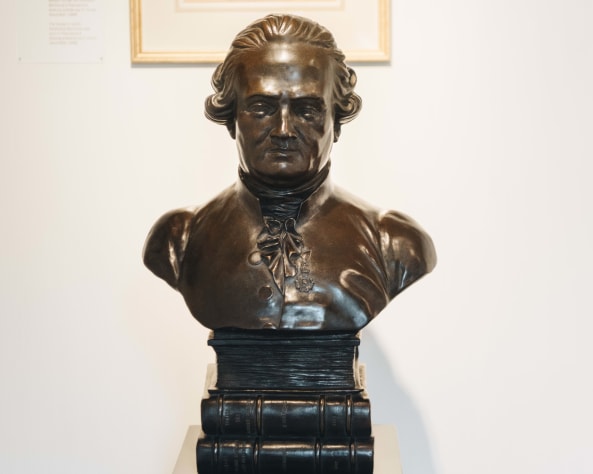
The name is derived from the title of a reference work published by Ferdinand Berthoud in 1787, "De la Mesure du Temps ou supplément au Traité des horloges marines et à l'Essai sur l'horlogerie [...]" (On the Measurement of Time or Supplement to the Treatise on Marine Clocks and the Essay on Horology), in which he sets out the principles of construction, execution and testing of small longitude clocks along with their application to pocket watches. This rigorously structured approach to knowledge helped standardise and pass on technical best practices within the watchmaking community, as well as supporting the development and production of increasingly accurate, reliable watches.
A mechanical show staged on the dial side
The lineage is clear: the new Calibre FB-TV.FC uses the same regulating principle as its predecessor, combining a tourbillon and a fusee-and-chain mechanism. But that is where the comparison ends and the innovation stemming from six years of R&D begins.
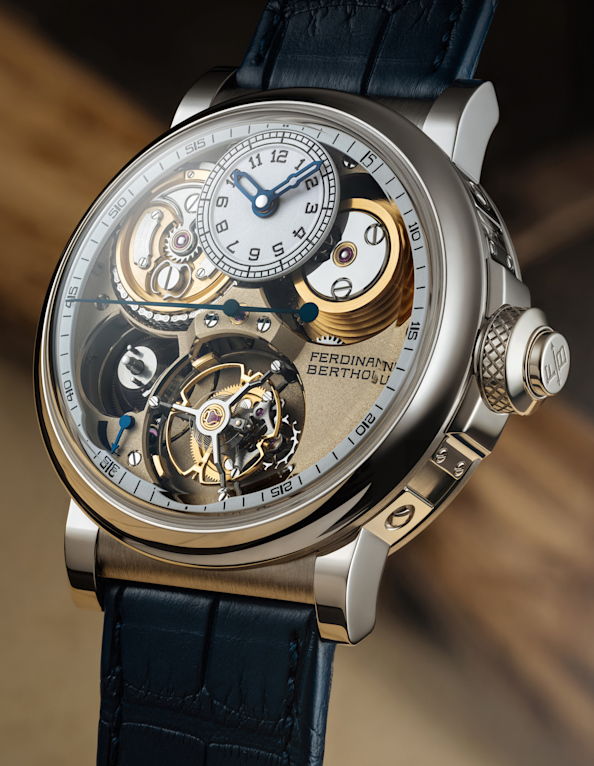
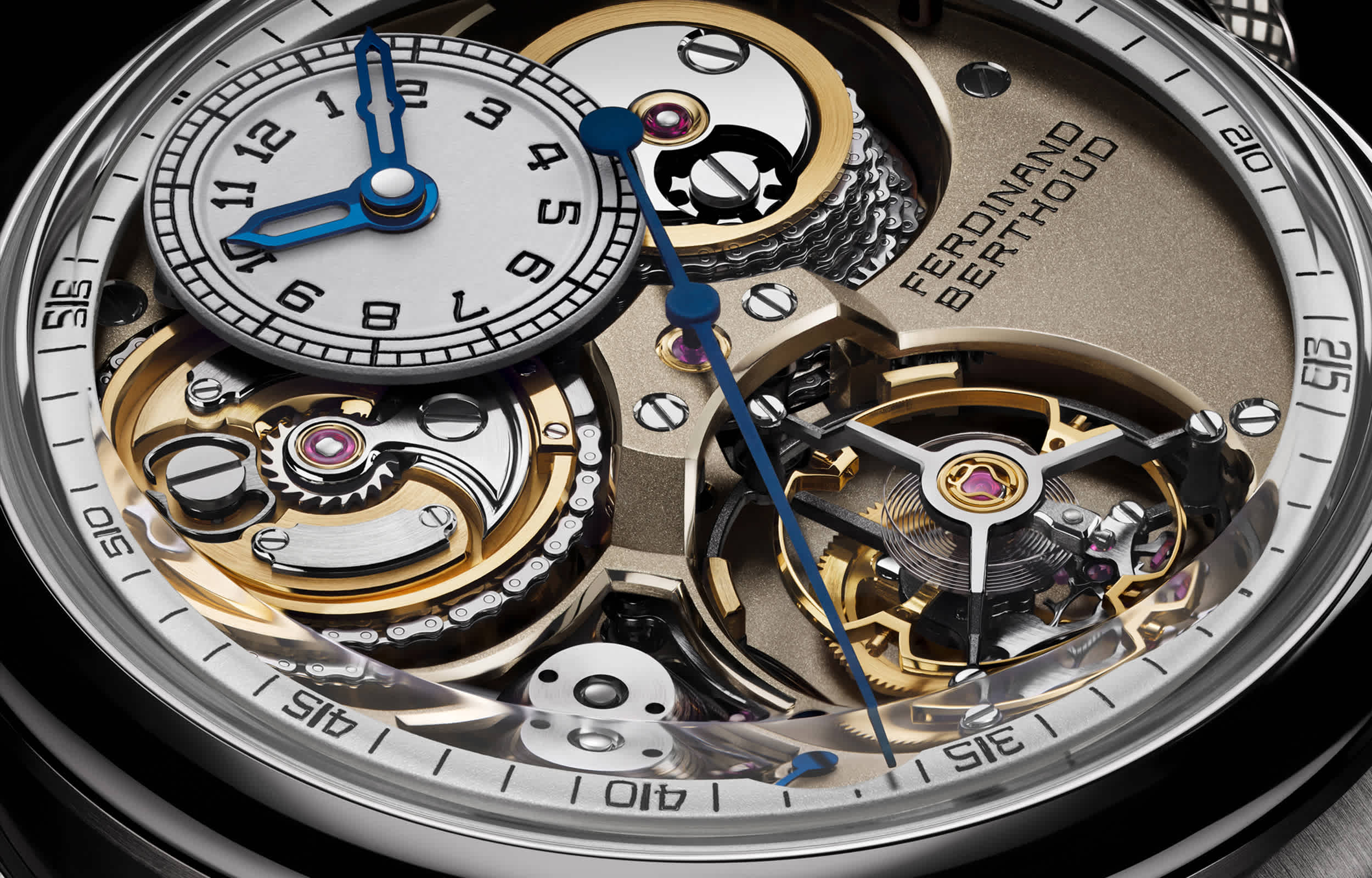
The tourbillon is now of the flying variety, meaning without an upper bridge It is supported solely by the intermediate bridge, to which the fixed seconds wheel and the cage carrier are attached, with their jewels ensuring the guidance of the entire mechanism. Featuring a spectacular 15 mm diameter, its three-spoked profile alternates between flat and sloping sections, echoing the shape of the centre bridge.
The primary intention of the new Calibre FB-TV.FC has thus been achieved: to render almost its entire mechanism visible on the dial side. Highly anticipated by collectors, this approach also provides a chance to showcase the Chronométrie's decorative expertise to the full. The movement's 1,240 components – including 777 elements for the chain alone – require nearly 300 hours of manual finishing, in accordance with the most stringent quality criteria. Furthermore, the flying tourbillon suspended by a single bridge reinforces the coherence with the rest of the movement built on pillars and whose main components are also suspended (fusee, barrel, power-reserve cone).
Two complications dedicated to precision timekeeping
The innovation of Calibre FB-TV.FC goes even further by incorporating two new features resulting from Ferdinand Berthoud's quest for chronometric excellence.
The first serves to stop the flying tourbillon carriage and the watch itself: the stop-seconds (balance-stop) mechanism immobilises the seconds hand and the entire movement.
Traditionally, this function is used to set the time: the movement is stopped, the desired time is set and then the movement is restarted.
Another complication to reset the central seconds hand was therefore developed.
Initially designed to be activated once the movement had stopped, Chronométrie Ferdinand Berthoud wanted to make the experience of this additional complication more natural by enabling resetting of the movement while it is running, in flyback mode.
Traditionally, the term “flyback” refers to is a complication associated with a chronograph module. It enables the wearer to stop the time measurement, zero-reset it and restart it with a single push of a button. Nonetheless, this apparent similarity with the chronograph is actually misleading, since this new development – incorporated into the flying tourbillon and fusee-and-chain architecture of Calibre FB-TV.FC – is of peerless complexity.
The design of this flyback-type resetting thus required many months of development for this complication in which speed meets precision. The seconds hand must return to zero perfectly and within a fraction of a second invisible to the naked eye. A new titanium filamentary hand has been specially created to absorb the power of zero-resetting that must not cause any vibration. This risk inherent to the classic construction of a flyback chronograph has been avoided through the use of a specially shaped cam, more commonly found in perpetual calendars. Simple and directly accessible, the flyback-type zero-resetting of the seconds hand is activated by a coaxial pusher embedded in the dynamometric winding crown at 3 o'clock.
A thoroughly redesigned movement
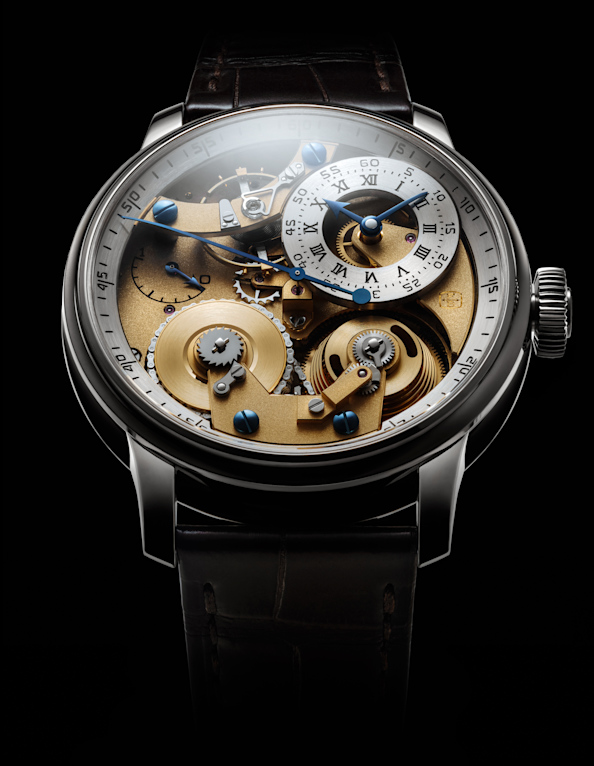
Several other optimisations have been made to the new movement of the Chronomètre FB 2TV belonging to the "Mesure du Temps 1787" collection. Contrary to the inverted-fusee cone of Calibre FB-T.FC, the new Calibre FB-TV.FC features a conventional orientation, with the smaller diameter facing upwards. The geometry of the fusee has been redesigned to adapt to the mainspring’s discharge curve. It has also been equipped with a double superimposed Maltese cross-type stopwork system and two stopwork fingers to ensure secure stopping, thereby reducing winding to approximately 6.25 turns of the crown. The fusee also incorporates a new triple satellite planetary differential system, integrated into its base and ensuring the movement continues running even during winding. Within this particularly compact configuration, the ratchet wheel naturally occupies its place beneath the fusee’s cone, in contrast to that of Calibre FB 01, which was located above it.
As for the 465 links of Calibre FB-TV.FC’s chain, secured by 311 pins and a hook, their thickness has been trimmed, compared to those of Calibre FB-T.FC.
The flying barrel of Calibre FB-TV.FC has also been completely redesigned. Unlike that of Calibre FB-T.FC, the drum no longer has grooves around its circumference, thereby limiting friction when the chain is wound or unwound on its surface.
The barrel has also been equipped with a new pre-winding system, visible at its top and consisting of a winding pawl with a saw-toothed wheel. This enables watchmakers to wind the mainspring during assembly of the calibre, before disengaging it by pivoting it 180 degrees on its axis.
The geometry of the mobile power-reserve cone and its mobile arm have also been adapted to their new location on the dial side, as well as to the number of rotations of the barrel drum.
This patented mechanism is linked to the barrel by a drive wheel that leverages the winding and unwinding movement of the mainspring to raise and lower a truncated cone along a threaded arbor fixed into the mainplate. The mobile arm tipped with a watch jewel acts as a sensor measuring the cone’s diameter and thus transmitting the movement's power-reserve level to a hand.
These developments offer three direct benefits:
- more constant torque, thus improving chronometry
- an increase in power reserve from 53 to 60 hours
- faster winding involving ten less turns to achieve full winding.
These advances resulting from six years of R&D along with and shock- and wear-resistance testing have profoundly changed the movement’s 3D aesthetics. New solutions have thus been adopted to maintain a consistently harmonious visual experience. Among them are a new finishing gear train designed on the rear side of the movement. A spectacular 28 mm-diameter gear wheel connects the moving parts at 3 o'clock and 12 o'clock, linking the offset hours and minutes display (at 12 o'clock) and the crown (at 3 o'clock).
This unusual configuration is the result of a technical constraint rather than a stylistic choice. It relates to the correction of the time within a flying-type structure, as well as to the presence of a compact differential placed under the fusee. It streamlines the contact points and ensures maximum efficiency in the transmission of information. Enhanced by the alignment of the finishing gear train, this purely mechanical approach echoes the solutions favoured by Ferdinand Berthoud in the construction of his marine clocks.
A case and display designed to magnify the mechanism
Measuring 44 mm in diameter and 15.46 mm thick, the round case of Chronomètre FB 2TV echoes the shape of the Remontoir d'Egalité FB 2RE model introduced in 2020. It is enhanced by a curved bezel set with a domed glare-proofed sapphire crystal.
This unique construction enables the interior space to accommodate the movement, while leaving the reset and time-setting mechanisms visible on the back of the watch.
An original solution has been developed to minimise the visual impact of this increased thickness, with the case-back also designed to also incorporate a domed crystal glare-proofed on both sides, similar to that used on the front of the watch.
At 12 o'clock, an off-centred hours and minutes subdial secured by pillars recalls the aesthetics of the original Chronomètre FB 1. The white varnished dial base and engraved black varnished minutes track, along with the faceted, hollowed-out, diamond-polished hands in blue CVD-coated 18-carat gold ensure optimal readability of the time.
Around the edge, a thin white lacquered inner bezel ring likewise secured by four pillars enables the seconds to be read off by means of a 25.80 mm long filamentary hand. Monobloc and made of blue CVD-treated sandblasted titanium, it sits at the centre of a three-dimensional bridge that is bevelled, engraved and finely sandblasted by hand.
Finally, at 7:30, the movement's power reserve – delivered via the stylised arm of a suspended mobile cone – is indicated by a blue CVD-treated bronze alloy hand moving across a short engraved, black-varnished segment on the centre bridge.
A traditional, timeless model has been chosen, as this timepiece is housed in an 18-carat white gold case enhanced by a hand-sanded natural nickel silver movement (Reference FB 2TV.1), as a nod to Chronomètre FB 1.1 that won the “Aiguille d'Or” Grand Prix at the 2016 GPHG awards.
Chronomètre FB 2TV is not subject to any specific limitation and its availability depends exclusively on the workshop's production capacity, estimated at between 10 and 12 timepieces per annum.
The new "Mesure du Temps 1787" collection thus embodies the convergence between traditional watch architecture, mechanical innovations in the realm of chronometry and the sculptural highlighting of each movement component. This unprecedented approach marks the start of a new decade at Chronométrie Ferdinand Berthoud.